
ONE YEAR OF FCA PRACTICE: A BLUEPRINT FOR CLEAR RULES FOR LARGE-SCALE BATTERY STORAGE
Together with the grid operator, battery storage developer and operator green flexibility looks back on 12 months of grid-neutral battery storage operation: an FCA blueprint developed from real-world practice — with a clear critique of overly restrictive market approaches.
AN FCA BLUEPRINT FOR THE INDUSTRY
Current discussions in the market around FCA requirements for large-scale battery storage systems sometimes go too far. They are often too restrictive, economically problematic and, in some cases, not effective from a grid-technical perspective. Instead of integrating storage systems into the energy system in a grid-compatible way, rigid or blanket requirements — as well as restrictions on operational flexibility — risk unnecessarily slowing down their expansion and use.
Over the past months, green flexibility has negotiated more than 15 FCAs across a wide range of grid areas, including with LEW Verteilnetz, in the Ostmünsterland region and with VWEW-energie. These negotiations have provided valuable insights into which provisions are practicable, where blanket requirements reach their limits, and how grid security, flexibility and economic viability can be better balanced.
In addition, further valuable insights have been gained together with the grid operator AllgäuNetz through the operational use of the battery storage system in Immenstadt. For around one year, one of Germany’s first grid-neutral large-scale battery storage systems based on an FCA has been in operation there.

“Overly generic or overly restrictive FCA requirements ultimately do not help the grid. They can prevent flexibility instead of making it usable in a targeted way. From our perspective, what is needed are practice-proven models that ensure grid security without unnecessarily limiting the systemic role of battery storage.”
Leandra Boes
Director Commercial Asset Management
Based on these experiences, a blueprint has been developed from real-world practice — built on the actual interaction between battery storage operator and grid operator.
The blueprint is based in particular on dynamic power limitations, a full-load-hour-based restriction model and the systemic control of balancing power. It combines grid stability, planning security and economic flexibility, and follows a standardized, parameter-based approach that differentiates between grid neutrality and grid supportiveness while consistently aligning restrictions with the actual grid situation.
“The proposals put forward by major distribution system operators show, by way of example, that FCAs are still too often understood in the market as an instrument of restriction — rather than as an intelligent operating model for the grid-compatible integration of battery storage. Against the backdrop of the growing role of storage systems in distribution grids, their interaction with grid operation is becoming increasingly important. Shifting forecasting responsibility to storage operators is just one example of where current approaches fall short. Those who want grid-secure, transparent and non-discriminatory power limitations must place this responsibility where the relevant grid data and system responsibility lie: with the grid operator.”
Volker Wiegand
Managing Director, AllgäuNetz

With the FCA blueprint, green flexibility presents a practice-proven template for future FCA agreements between battery storage operators and grid operators. In the AllgäuNetz grid area, further large-scale battery storage systems are set to be connected to the grid in 2027 as part of this first-of-its-kind FCA framework.
[The battery storage system in Immenstadt is a joint project with Allgäuer Überlandwerk and was commissioned in June 2025. 15 MW / 33 MWh — press release]
Our blueprint is intended as a practical offering for grid operators, municipal utilities and selected cooperation partners. The aim is to enter into dialogue, share experience and further develop possible approaches for future agreements. Interested partners from these areas are welcome to contact us via the form.
Key Insights at a Glance
The rapid deployment of utility-scale battery storage is a key pillar of the energy transition. At the same time, the “battery tsunami” is presenting grid operators, battery storage operators and energy traders with new technical, operational and economic challenges. In particular, four operating requirements are increasingly coming into focus: active power restrictions, reduced active power ramp rates, limits on marketable balancing power, and advance scheduling requirements. While these measures are intended to safeguard grid stability, they also create systemic effects that extend far beyond the operation of individual battery storage systems.
For green flexibility, the objective of this brief study is therefore clear: to give equal consideration to the perspectives of grid operators, energy traders and battery storage operators, and to establish a shared understanding of the underlying mechanisms. Only in this way can future instruments be developed that safeguard grid stability while preserving the economic value of flexibility for society as a whole.
“At green flexibility, we want to be part of the solution. This requires listening to one another and understanding how different tools can align the interests of the grid, the market, the wider power system and battery storage operations. When we jointly assess the impact of these approaches, we can develop solutions that benefit everyone. This is precisely where we want to make a meaningful contribution,” says Christina Hepp, Director Strategy at green flexibility.
Our analysis shows:
The restrictions address real challenges in grid operation. At the same time, they can create economic disadvantages that, if applied across the board, may impair the efficiency of the electricity market, the utilisation of existing grid capacity and the flexibility of the power system as a whole.
Key Findings from the Four Operating Restrictions Analysed
1. Active Power Restrictions
They reduce local grid risks and ensure predictable grid utilisation.
However, the specific design determines their economic impact:
-
Static power limits result in 5,840 restricted hours in the grid area analysed, while dynamic restrictions achieve almost the same grid-planning effect with just 240 hours.
-
The impact on revenues differs accordingly: static operating envelopes –25%, dynamic requirements –1%.
This results in the loss of valuable flexibility, particularly when battery storage systems could otherwise help relieve the power system. This can entrench market structures, reduce liquidity and significantly diminish the overall economic value of battery storage.
2. Advance Scheduling Requirements
Advance scheduling requirements increase controllability for grid operators, but remove the most flexible technology from the market precisely when intraday liquidity and forecast adjustments are most urgently needed. This leads to more extreme price movements, higher balancing energy requirements and rising system costs. A far-reaching restriction of intraday flexibility would significantly undermine the core value of utility-scale battery storage. It is therefore important to find solutions that take both grid security and short-term flexibility into account.
3. Limits on Active Power Ramp RatesSlower ramp rates reduce frequency deviations caused by rapid changes in output — but prevent battery storage systems from responding quickly to forecast errors or volatile generation patterns. In the model, revenues decline by 13% under a 6% ramp-rate requirement. At the same time, the system loses one of the key advantages of battery storage: speed and immediate balancing capability.
4. Limits on Marketable Balancing PowerFrom a grid perspective, such limits are understandable, as balancing power activations are difficult to predict. Economically, however, they can be problematic: limiting balancing power to 20% of installed capacity reduces the balancing power dispatched by a 10 MW battery storage system by up to 50% — despite cross-market optimisation. This reduces supply, drives up prices and shifts battery storage systems more heavily towards the wholesale market, where this can in turn create additional load peaks.
Shared Economic Challenge
All four requirements follow a recurring pattern: they are intended to address local grid challenges, but at the same time create system-wide efficiency losses, higher costs for consumers, reduced market flexibility and, in the long term, weaker investment incentives — precisely the effects that can undermine a successful energy transition.
Potential Solutions — and Why Dialogue Is Essential
The study shows that rigid requirements rarely lead to optimal solutions.
Instead, dynamic, data-driven and grid-state-based models could ensure grid security without significantly limiting the economic value of utility-scale battery storage.
Examples include
• dynamic active power restrictions instead of static operating envelopes
• site-specific rather than blanket ramp-rate requirements, as well as decoupling physical and balancing volumes
• dynamic flexibility for balancing power market participation
• greater data exchange, including the provision of granular scheduling data
These approaches are intended to provide a basis for further discussion and represent potential directions — building blocks for a future in which all stakeholders can benefit.
Our Conclusion: The Best Solution Is Developed Together
Battery storage operators, grid operators and energy traders each pursue legitimate objectives. The challenge is to consider these objectives not in opposition to one another, but as parts of a shared solution.
We want to be part of the solution — not by putting forward predetermined demands, but by bringing openness, data, analysis and a willingness to engage in dialogue.
Only by working together in this way can we ensure grid security, market liquidity and economic efficiency at the same time.
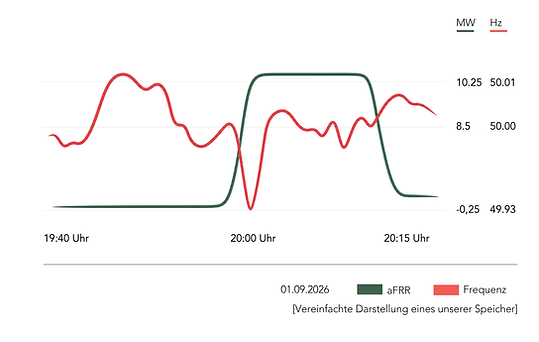
Praxisbeispiele aus dem realen Speicherbetrieb zeigen, zeigen das Potenzial von Batteriespeichern für Netz- und Systemstabilität.
Wenn Sekunden zählen - Unsere Speichern haben geliefert
Beim kurzfristigen Ausfall mehrerer Kraftwerksblöcke im September 2026 reagierten unserer Großbatteriespeicher innerhalb weniger Sekunden auf den automatischen Abruf von Sekundärregelleistung (aFRR) und trug zur Stabilisierung der Netzfrequenz bei.
Solche Ereignisse verdeutlichen, dass Batteriespeicher ihr Potenzial für Netz- und Systemstabilität nur dann voll entfalten können, wenn sie nicht durch pauschale und dauerhafte Einschränkungen begrenzt werden. Der FCA Blueprint zeigt praxisnahe Ansätze, wie Netzsicherheit und ein leistungsfähiger Speicherbetrieb sinnvoll miteinander verbunden werden können.